

Microsoft, Google, Meta, and Amazon are spending more than $650 billion on AI infrastructure this year.
Look, they have the chips ready, and they certainly have enough land to build those projects.
Naturally, Big Tech also has the engineers, the fiber, the cooling systems, and the permits to get the job done.
But what a surprising number of them don’t have — and can’t get on any timeline they planned for — is an appointment with the power company.
That’s not an exaggeration, folks.
Out of the 12 gigawatts of AI data center capacity announced for 2026, only about 5 gigawatts is actually under active construction.
The other 7 gigawatts has been canceled or delayed — not because of chip shortages, financing problems, or regulatory hurdles, but because the electrical infrastructure to power those facilities simply doesn’t exist yet.
That’s 7 gigawatts stuck waiting on a grid that simply can’t keep up.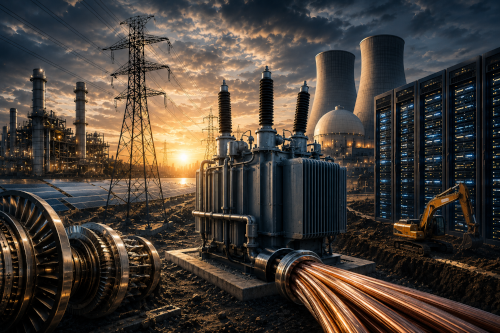
And the part that you may not see splashed across headlines today is that the binding constraint on the entire AI buildout isn’t GPUs, isn’t bandwidth, isn’t data center real estate.
It’s a metal box filled with copper wire.
You might know it by another name: a transformer.
Transformers are the same piece of equipment that’s been stepping voltage up and down on every street corner in America for a hundred years.
And the most sophisticated technology in history just ran headfirst into one of the oldest bottlenecks in power engineering.
The catch here is that the wait-list to fix it isn’t measured in months — we’re talking years!
The Best Free Investment You’ll Ever Make
Our analysts have traveled the world over, dedicated to finding the best and most profitable investments in the global energy markets. All you have to do to join our Energy and Capital investment community is sign up for the daily newsletter below.
The Power Crisis (And Solution) Buried Under AI Headlines
A high-voltage transformer is not a glamorous piece of equipment.
Nobody holds a product launch event for them, nor will you see a version 2.0.
These are large, filled with specialized dielectric oil, custom-engineered devices that take high-voltage electricity from the transmission grid and step it down to usable levels for large industrial customers.
Yes, that includes every major data center ever built, or that will come online in the near future.
Before the AI buildout started in earnest, lead times for large power transformers ran up to a year and a half. And even though demand has exploded, supply chains haven’t, which has stretched those lead times to nearly four years in some cases — from order to delivery for the equipment you need before you can flip a single switch.
To be clear, manufacturers aren’t sandbagging anyone.
In fact, there are only a handful of companies in the world capable of building the largest high-voltage transformers at scale, and you can bet their order books are full.
You just can’t spin up a transformer factory the way you spin up a chip fab. The specialized steel, the skilled labor, the testing equipment — it takes years to build that capacity, and nobody was building it when demand was flat.
Now consider that a new AI data center announced today needs power connections, yet the transformer it truly needs won’t be delivered until 2028 or 2029 at the earliest.
Of course, the transmission infrastructure connecting it to the grid — which requires its own permitting, engineering, and construction timeline — can take up to a decade to fully build out.
Meanwhile, the AI models being trained in these facilities are doubling in capability every 12 to 18 months.
At this point, something has to give.
According to PJM Interconnection — the grid operator covering 65 million people across 13 states — projects it will be 6 gigawatts short of its own reliability requirements in 2027.
In other words, we’re not talking about a problem we’ll need to address further down the road.
This is next year!
In fact, looking at Morgan Stanley’s models, there’s a 49 gigawatt power shortfall in the United States alone by 2028.
Our grid wasn’t built for what’s being asked of it, and the upgrade cycle is running years behind the demand curve.
How We Power Our Way Out
Look, our path forward has two distinct phases, and it shouldn’t be surprising to learn that the smart money is already positioned in both of them.
If our eyes are on the near term, there’s no question that natural gas will carry the burden.
But that makes sense, right?
After all, the operational reality of the American grid is that natural gas generates roughly 40% of U.S. electricity — more than any other single source!
More important is that it’s dispatchable, which means we can crank it up when demand spikes, and dial the power back when it doesn’t. That’s the kind of baseload power that needs to be the backbone of grid reliability.
Granted, it’s also the only fuel source that can deploy new generation capacity fast enough to matter in the 2026 to 2030 window.
You see, new gas-fired combined cycle plants can go from permitting to operation in three to five years — that’s faster than nuclear and large-scale renewables.
It’s also dramatically faster than the transmission infrastructure to connect remote projects to the load centers that need the power.
For every data center campus that finally gets its transformer and grid connection, a natural gas plant somewhere is running harder to supply it.
However, the longer-term story belongs to nuclear energy.
Right now, there’s about 94 commercial nuclear reactors generating nearly 20% of the nation’s electricity — the largest source of carbon-free baseload power in the country.
Again, these plants run 24 hours a day, 7 days a week, regardless of whether the wind is blowing or the sun is shining. For a data center operator signing a 20-year power purchase agreement, that reliability is worth paying for.
The next generation will go further, too.
Small modular reactors — factory-built, standardized, deployable in a fraction of the time and cost of conventional plants — are moving from demonstration projects toward commercial reality.
Although no Western SMR are in operation yet (we’ve seen some licensing milestones so far), those power purchase agreements and capital commitments from Big Tech are pointing in one direction.
The AI revolution isn’t slowing down, and the question isn’t whether America powers its AI buildout, the real question is which fuel will do it.
Those power players positioned at that intersection — gas, grid, and nuclear — are where I’ve been spending my research time.
Until next time,

Keith Kohl
 Check us out on YouTube!
A true insider in the technology and energy markets, Keith’s research has helped everyday investors capitalize from the rapid adoption of new technology trends and energy transitions. Keith connects with hundreds of thousands of readers as the Managing Editor of Energy & Capital, as well as the investment director of Angel Publishing’s Energy Investor and Technology and Opportunity.
For nearly two decades, Keith has been providing in-depth coverage of the hottest investment trends before they go mainstream — from the shale oil and gas boom in the United States to the red-hot EV revolution currently underway. Keith and his readers have banked hundreds of winning trades on the 5G rollout and on key advancements in robotics and AI technology.
Keith’s keen trading acumen and investment research also extend all the way into the complex biotech sector, where he and his readers take advantage of the newest and most groundbreaking medical therapies being developed by nearly 1,000 biotech companies. His network includes hundreds of experts, from M.D.s and Ph.D.s to lab scientists grinding out the latest medical technology and treatments. You can join his vast investment community and target the most profitable biotech stocks in Keith’s Topline Trader advisory newsletter.


